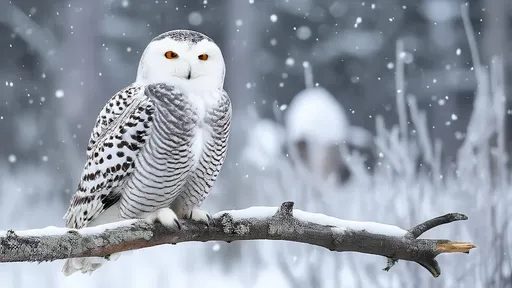
In the silent, snow-blanketed expanses of the Arctic, the Snowy Owl reigns as a master hunter, its prowess honed by one of nature's most sophisticated auditory systems. Unlike many predators that rely primarily on vision, the Snowy Owl has evolved an extraordinary ability to pinpoint prey through sound alone, a critical adaptation for survival in an environment where daylight is scarce for much of the year and prey often moves beneath the snow. This acoustic precision transforms the owl into an efficient and deadly snowbound sentinel, capable of detecting and striking with remarkable accuracy even in complete darkness or through layers of snow.
The anatomy of the Snowy Owl's auditory system is a marvel of evolutionary engineering. Its facial disc, a distinctive concave arrangement of feathers, acts as a parabolic reflector, channeling sound waves toward the ears with exceptional efficiency. This disc is asymmetrical, a feature not unique to Snowy Owls but highly developed in them; one ear opening is positioned higher than the other, both in terms of vertical placement on the skull and sometimes even in the structure of the skull itself. This asymmetry means that a sound reaches one ear a fraction of a second before the other and at a slightly different intensity. The owl's brain is exquisitely tuned to process these minute differences in timing and volume, allowing it to calculate the precise vertical and horizontal coordinates of the sound's source in a three-dimensional space. It’s a biological system of triangulation more advanced than any human-made technology.
Further enhancing this system is the owl's entire head, which functions as a sophisticated sound-gathering apparatus. The rigid, flat facial skeleton provides a stable platform for the facial disc feathers, and the owl can subtly alter the shape of this disc by contracting special muscles to focus on specific frequencies or to better capture faint noises. The ear openings themselves are also covered by specialized feathers that form a movable operculum. These feathers can be adjusted to alter the size and shape of the ear opening, effectively filtering and modulating incoming sounds without dampening them, allowing the owl to isolate the faint rustle of a lemming under 30 centimeters of snow from the constant background noise of the wind.
This auditory capability is not merely for detection; it is the cornerstone of the Snowy Owl's hunting strategy. In the deep winter, when voles and lemmings, their primary prey, remain active in subnivean tunnels beneath the snowpack, vision becomes nearly useless. The owl must hunt by ear. It will perch silently on a ridge or hummock, its white plumage providing perfect camouflage, and simply listen. Its head swivels up to 270 degrees, not as a cartoonish gimmick, but as a precise mechanism to scan the acoustic landscape without moving its body and creating noise. Once it detects a faint scratch or squeak, it turns its head to align the sound source directly in front of it, where its auditory reception is most accurate. It then calculates the exact depth and position of the prey.
The strike itself is a silent, explosive culmination of this acoustic calculation. The owl launches from its perch, its broad wings enabling near-silent flight due to specialized serrated feathers that break up turbulent air. It flies directly to the spot it has mapped in its mind, often hovering for a split second before plunging feet-first through the snow crust. Its powerful talons, spread wide, act like a net, snapping shut the instant they contact the prey. The entire process, from detection to capture, is guided almost exclusively by sound. Research has shown that Snowy Owls can successfully locate and capture prey hidden under snow with a success rate that would be impossible without such advanced hearing, demonstrating a clear evolutionary advantage.
The environment of the Arctic plays a crucial role in the functionality of this system. The cold, dense air carries sound more efficiently, and the vast, open landscapes with minimal tree cover provide an acoustic environment relatively free of echoes and reverberations that could confuse the owl's directional calculations. The snow itself, while a visual barrier, can act as a conductor of certain high-frequency sounds emitted by small mammals. The owl’s hearing is particularly sensitive to these high frequencies, which travel well through the compacted snow of the subnivean zone, creating a clear auditory signal for the waiting predator. This perfect harmony between predator and environment is a testament to the power of natural selection.
Understanding the Snowy Owl's acoustic abilities has implications beyond pure biology. Biotechnologists and engineers study these mechanisms for inspiration in designing superior directional microphones, advanced hearing aids, and sophisticated navigation systems for robots and drones. The principles of asymmetric sound reception and parabolic collection are being reverse-engineered to create technology that can locate sounds with animal-like precision in noisy environments. The owl, a silent hunter of the tundra, is thus becoming an unlikely muse for the next generation of acoustic sensors.
In conclusion, the Snowy Owl's auditory system is far more than just a pair of sensitive ears. It is an integrated suite of anatomical adaptations—the asymmetrical skull, the parabolic facial disc, the movable operculum, and the neural processing power—that work in concert to create a lethal sound-based targeting system. This allows the owl to thrive in one of the planet's most challenging habitats, turning the seemingly impenetrable white landscape into a transparent field of acoustic signals. It is a profound example of how evolution can shape a creature into a perfect specialist, a ghostly white hunter whose greatest weapon is its ability to listen to the secrets hidden deep beneath the snow.

By /Aug 21, 2025
By /Aug 21, 2025

By /Aug 21, 2025

By /Aug 21, 2025
By /Aug 21, 2025
By /Aug 21, 2025

By /Aug 21, 2025

By /Aug 21, 2025

By /Aug 21, 2025

By /Aug 21, 2025

By /Aug 21, 2025
By /Aug 21, 2025

By /Aug 21, 2025
By /Aug 21, 2025

By /Aug 21, 2025

By /Aug 21, 2025

By /Aug 21, 2025

By /Aug 21, 2025

By /Aug 21, 2025

By /Aug 21, 2025