In the intricate world of ants, communication transcends the limitations of sound and sight, weaving a complex tapestry of chemical signals that guide every aspect of their societal functions. This silent language, composed of pheromones, serves as the backbone of their highly organized colonies, dictating behaviors from foraging to defense, and even the intricate care of their young. The study of these chemical signals reveals a sophisticated syntax, a grammar of scents that orchestrates the life of the colony with precision and efficiency.
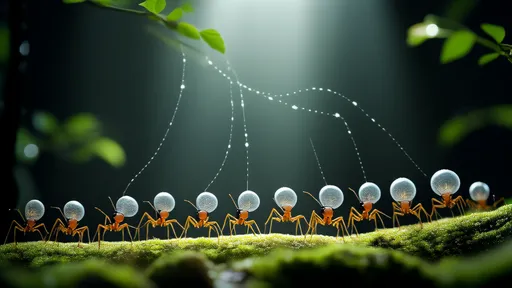
The foundation of ant communication lies in the diverse array of pheromones they produce, each with a specific message and purpose. These chemical compounds are secreted from various glands located throughout their bodies, allowing for a nuanced and multi-faceted dialogue. For instance, trail pheromones guide fellow workers to food sources, creating invisible highways that lead to sustenance. Alarm pheromones, on the other hand, broadcast danger, triggering immediate and coordinated defensive responses. The richness of this chemical lexicon enables ants to convey detailed information, from the location and quality of food to the presence of threats or the need for assistance.
What elevates this system from a mere collection of signals to a true language is its inherent structure—the grammar that governs how these pheromones are combined and interpreted. Researchers have discovered that ants do not simply release single pheromones in isolation; instead, they blend multiple compounds in specific ratios and sequences, much like words forming sentences. This combinatorial approach allows for a vast expansion of meaning, enabling ants to communicate complex instructions and adapt to dynamic environments. The timing and concentration of these emissions further refine the message, ensuring that the information is both accurate and contextually appropriate.
Consider the process of foraging, a critical activity for colony survival. When a scout ant discovers a food source, it returns to the nest laying a trail pheromone that marks the path. However, this trail is not a simple, unchanging line; its strength and composition vary based on the quality and quantity of the food. A rich discovery results in a stronger, more enticing trail, recruiting more workers to the site. As the food is depleted, the pheromone signal fades, redirecting labor to more promising ventures. This dynamic adjustment exemplifies the syntactic flexibility of ant communication, where messages are continuously updated to reflect current conditions.
Similarly, the coordination of nestmate recognition and colony defense relies on a delicate balance of chemical cues. Ants use cuticular hydrocarbons—chemical profiles on their exoskeletons—as identity badges, allowing them to distinguish friend from foe. These profiles are not static; they can change in response to environmental factors or colony needs, requiring ants to constantly "read" and interpret these signals. When an intruder is detected, alarm pheromones are released, but their effect is modulated by the context. A mild threat might trigger increased vigilance, while a severe danger could provoke an all-out attack, demonstrating how the grammar of pheromones enables graded responses.
The reproductive cycle of the colony also hinges on precise chemical communication. Queen ants emit pheromones that suppress the reproductive capabilities of workers, ensuring that the colony's resources are focused on her offspring. These queen signals are part of a broader regulatory syntax that maintains social harmony and directs the colony's growth. When the queen ages or dies, the decline in these inhibitory pheromones triggers a shift in behavior, with workers potentially developing their own reproductive abilities or raising new queens. This seamless transition underscores the robustness of the chemical language, which can adapt to significant changes without collapsing into chaos.
Beyond internal colony affairs, ants engage in interspecies communication using their chemical lexicon. Some species form mutualistic relationships with plants or other insects, using pheromones to negotiate these interactions. For example, certain ants protect aphids in exchange for honeydew, and they use chemical signals to "herd" and manage these tiny livestock. In other cases, parasitic ants infiltrate colonies of different species by mimicking their host's pheromones, a deceptive tactic that highlights the potential for exploitation within this chemical syntax. These complex interactions reveal that ant pheromones are not just a closed system but part of a broader ecological dialogue.
Advances in technology have allowed scientists to decode elements of this chemical language with increasing precision. Gas chromatography and mass spectrometry enable researchers to identify specific pheromone compounds, while behavioral assays help decipher their meanings. However, the full syntax remains elusive, as it involves not only the chemicals themselves but also their spatial distribution, temporal patterns, and the receptive capacities of the ants. Each species has evolved its own dialect, tailored to its ecological niche and social structure, adding layers of complexity to the study of ant communication.
The implications of understanding ant pheromone grammar extend beyond entomology, offering insights into fields such as robotics, computer science, and even linguistics. The efficient, decentralized coordination seen in ant colonies inspires algorithms for swarm robotics and network optimization, where agents must collaborate without central control. Similarly, the combinatorial nature of ant communication echoes principles in human language, suggesting that syntax may be a fundamental feature of complex information systems, whether biological or artificial. By studying how ants use chemistry to create meaning, we gain a deeper appreciation for the diversity of intelligence in the natural world.
In conclusion, the chemical language of ants, with its sophisticated grammar and dynamic syntax, represents one of the most fascinating communication systems in the animal kingdom. It enables millions of individuals to act as a cohesive unit, responding to challenges and opportunities with remarkable agility. As research continues to unravel the nuances of this pheromone-driven dialogue, we are reminded that language, in its broadest sense, is not confined to humans but is a versatile tool evolved by countless species to navigate their worlds. The humble ant, through its silent scents, teaches us that complexity often lies beneath the surface, waiting to be decoded.
By /Aug 21, 2025

By /Aug 21, 2025
By /Aug 21, 2025

By /Aug 21, 2025
By /Aug 21, 2025
By /Aug 21, 2025
By /Aug 21, 2025
By /Aug 21, 2025
By /Aug 21, 2025
By /Aug 21, 2025

By /Aug 21, 2025
By /Aug 21, 2025
By /Aug 21, 2025
By /Aug 21, 2025
By /Aug 21, 2025

By /Aug 21, 2025

By /Aug 21, 2025
By /Aug 21, 2025
By /Aug 21, 2025
By /Aug 21, 2025