In the vast, windswept tundras of the Arctic, the musk ox stands as a testament to resilience and collective strength. These shaggy, prehistoric-looking creatures have perfected a defense mechanism so effective it has allowed them to survive for millennia in one of the planet's most unforgiving environments. Their strategy is not one of individual flight or fight, but a deeply coordinated, collective action known as the phalanx or fortress defense. This is a story of tactical brilliance written in the snow, a symphony of instinct and cooperation that turns a vulnerable herd into an impenetrable fortress.
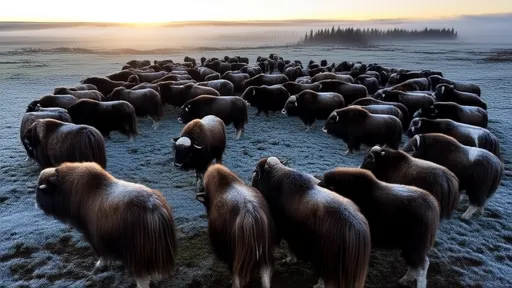
The core of this defense is the formation. When a threat is detected, typically by a sentry ox, a low guttural alarm call ripples through the herd. This is not a signal for panic, but a call to order. The adults, both bulls and cows, immediately begin to move. They do not scatter. Instead, they converge, their massive bodies forming a tight circle or a semicircle against a natural barrier like a cliff face. The youngest and most vulnerable members of the herd—the calves—are ushered into the very center of this living wall, protected on all sides by a barrier of muscle, horn, and thick, matted fur.
What makes this formation so formidable is the positioning of each individual animal. They stand shoulder to shoulder, facing outward, their heads lowered. This presents a unified front of formidable horns and reinforced skulls to the predator, most often a pack of Arctic wolves. The horns, curved and sharp, are not just for show; they are lethal weapons. But their power is magnified exponentially when arrayed in a continuous, defensive line. A wolf lunging at the formation is met not by a single set of horns, but by a coordinated counter-attack from several oxen. An attack on one is treated as an attack on all.
The coordination extends beyond static defense. The formation is dynamic. If a predator attempts to test a specific point in the circle, the oxen subtly shift their weight and adjust their positions, reinforcing the weak point. Larger, more experienced bulls often position themselves at the most likely point of attack, their sheer size acting as a bulwark. There is no visible leadership, no alpha barking orders. The coordination is seemingly telepathic, a product of evolved instinct and an intimate understanding of herd dynamics. Each ox knows its role and executes it with precision, creating a collective intelligence far greater than the sum of its parts.
This tactic is a brilliant exploitation of the musk ox's natural advantages while mitigating its weaknesses. An individual musk ox, while powerful, is relatively slow and can be isolated and worn down by a persistent wolf pack. The circle formation nullifies this possibility. It prevents the predators from isolating a single target, forcing them to confront the herd's combined strength. The wolves are presented with a dilemma: abandon the hunt or risk severe injury from a deadly forest of horns for a minuscule chance of success.
The success of this phalanx defense is a powerful lesson in the evolutionary advantage of cooperation over solitary strength. It is a strategy born from necessity in an environment where a single mistake can mean death. For the musk ox, survival is not an individual pursuit but a collective responsibility. Their continued existence in the harsh Arctic biome is a direct result of this unwavering commitment to communal defense, a timeless dance of life and death performed on a stage of ice and rock.
Observing a musk ox herd form its defensive perimeter is to witness a seamless transition from peaceful grazing to a military-grade defensive stance in a matter of seconds. There is no hesitation, no debate. The communication is subtle—a shift in posture, the angle of a head, a soft grunt. This flawless execution suggests that the knowledge is hardwired into their very being, passed down through countless generations. It is a perfect, instinctual response to a threat that has pursued them for ages.
The psychological impact of this formation on predators cannot be understated. A pack of wolves, confident in chasing a caribou, must completely recalibrate its strategy when facing the musk oxen's circle. The unified front projects an aura of invincibility and deterrence. Often, wolves will circle the formation for hours, looking for a break in discipline that never comes. They eventually leave, their energy expended for no reward. The musk oxen, having stood their ground without a single casualty, will hold the formation for a long time after the wolves have departed before slowly dispersing and returning to grazing. Their vigilance is constant.
This remarkable behavior transcends mere animal instinct; it offers a profound metaphor for collective security. The strength of the group protects the individual, and the commitment of each individual ensures the survival of the group. The calves in the center represent the future, their safety being the entire purpose of the dangerous stand taken by the adults. It is a powerful, silent contract between the members of the herd—a promise of protection in exchange for participation. This is the true essence of the musk ox's strategy: a perfect, evolved balance between self-preservation and altruism.
In the end, the musk ox’s group defense system is one of nature's most elegant and effective survival strategies. It is a masterclass in tactical positioning, communication, and selfless cooperation. While the Arctic wind howls and predators prowl, the herd stands united, an ancient fortress upon the frozen plain, proving that together, they are far more than just a group of individuals—they are an unbreakable whole.
By /Aug 21, 2025
By /Aug 21, 2025
By /Aug 21, 2025

By /Aug 21, 2025
By /Aug 21, 2025
By /Aug 21, 2025
By /Aug 21, 2025
By /Aug 21, 2025

By /Aug 21, 2025
By /Aug 21, 2025

By /Aug 21, 2025
By /Aug 21, 2025
By /Aug 21, 2025
By /Aug 21, 2025
By /Aug 21, 2025

By /Aug 21, 2025

By /Aug 21, 2025
By /Aug 21, 2025

By /Aug 21, 2025

By /Aug 21, 2025