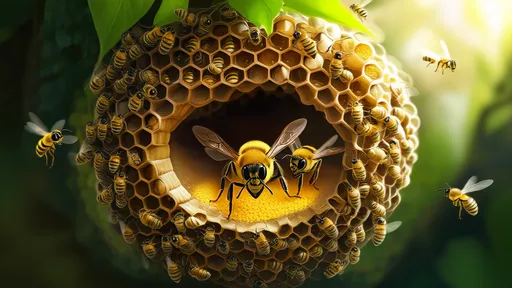
In the intricate world of honeybee colonies, one of nature's most fascinating phenomena unfolds each spring: the democratic decision-making process of swarm selection. When a hive becomes overcrowded, the queen and a portion of workers depart to establish a new home, leaving behind a successor. The fate of the swarm hinges on a collective choice made not by a single leader, but through a sophisticated process of debate and consensus-building that has captivated scientists for decades.
At the heart of this process are the scout bees, experienced foragers who venture out to identify potential nesting sites. These sites vary in quality, with factors like cavity size, entrance height, dryness, and orientation influencing their suitability. Each scout returns to the cluster and communicates her discovery through the famed waggle dance, whose vigor and duration reflect her enthusiasm for the site's attributes. This dance isn't merely a announcement; it's a persuasive argument, aiming to recruit other scouts to verify and endorse the location.
The mathematical modeling of this decision-making process reveals a stunningly efficient system that balances speed with accuracy. Researchers like Thomas Seeley and Kevin Passino have developed models showing how bees avoid both hasty decisions and deadlock. Their studies demonstrate that a site's quality correlates directly with the number of scouts advocating for it through dances. Higher-quality sites trigger more vigorous and longer-lasting dances, attracting more verifiers. This creates a positive feedback loop: the better the site, the stronger its support grows.
Critically, the models incorporate a key mechanism: scouts eventually stop dancing for inferior sites. As they encounter competing dances or personally inspect alternative locations, they may abandon their initial preference and switch allegiance to a superior option. This self-correction prevents the group from fragmenting among multiple mediocre choices. Mathematical simulations show that this cross-inhibition—where support for strong options actively suppresses support for weaker ones—is crucial for reaching a unanimous decision.
Another mathematical aspect involves quorum sensing. The models indicate that scouts don't merely count dances; they gauge when a threshold of consensus is reached. Once a sufficient number of scouts (typically 15-30) are concurrently advocating for a single site, a signal spreads through the swarm. This quorum triggers the shift from deliberation to action: scouts that had been quietly assessing options begin piping signals that excite the swarm and initiate preparation for flight.
The timing of this decision is mathematically optimized. Models factoring in energy reserves, weather threats, and predation risks show that bees have evolved to make this decision within a timeframe that minimizes danger without sacrificing choice quality. Spending too long risks starvation or exposure, while deciding too quickly might mean selecting a inferior cavity. The observed process typically concludes within several hours to a few days, striking this balance perfectly.
Interestingly, these models have transcended biology, inspiring algorithms in robotics and computer science. "Bee-inspired" decision-making models are now used in swarm robotics where decentralized robot groups must reach consensus without central control. Engineers have applied these principles to develop systems for collective decision-making in drone teams or distributed sensor networks, proving the practical value of understanding apian democracy.
The mathematics also reveals how honeybees avoid information cascades—where individuals follow early signals without independent verification. By requiring scouts to personally inspect sites before dancing, the colony ensures decisions are based on multiple independent assessments rather than blind imitation. This prevents the group from rushing toward a poor choice based on initial, potentially flawed, information.
Furthermore, models show that diversity among scouts enhances decision quality. Scouts vary in their sensitivity to dance stimuli and their persistence in advocating for sites. This variation ensures that multiple options are thoroughly explored before one dominates. Without this diversity, the process might converge too quickly on the first adequate site rather than the best available one.
Recent mathematical work has even incorporated the role of stop signals—brief vibrations that scouts sometimes use to inhibit dances for competing sites. These negative signals help prune poor options from consideration, accelerating consensus around the best choice. The interplay between positive (dances) and negative (stop signals) feedback creates a dynamic system that reliably identifies optimal solutions.
The precision of this natural system is staggering. Mathematical analyses confirm that bee colonies achieve approximately 90% accuracy in selecting the best available site—a success rate that would impress any human committee. This reliability emerges not from any individual's intelligence, but from the clever integration of simple rules followed by each bee.
As research continues, newer models are incorporating more complex variables, such as how bees might weigh multiple criteria simultaneously or how decision-making changes under environmental stress. These refined models continue to reveal the elegance of evolution's solutions to collective problems.
The study of honeybee democracy stands as a powerful testament to how sophisticated collective intelligence can emerge from simple individual behaviors. Its mathematical modeling not only deciphers one of nature's wonders but provides blueprints for improving our own collective decision-making systems, from business organizations to digital networks. In the humble honeybee, we find a masterclass in democracy written in the language of mathematics.

By /Aug 21, 2025

By /Aug 21, 2025
By /Aug 21, 2025

By /Aug 21, 2025
By /Aug 21, 2025
By /Aug 21, 2025
By /Aug 21, 2025
By /Aug 21, 2025

By /Aug 21, 2025
By /Aug 21, 2025

By /Aug 21, 2025

By /Aug 21, 2025

By /Aug 21, 2025
By /Aug 21, 2025
By /Aug 21, 2025

By /Aug 21, 2025

By /Aug 21, 2025

By /Aug 21, 2025

By /Aug 21, 2025

By /Aug 21, 2025